Replacement crew docks at space station, boosts crew back to seven
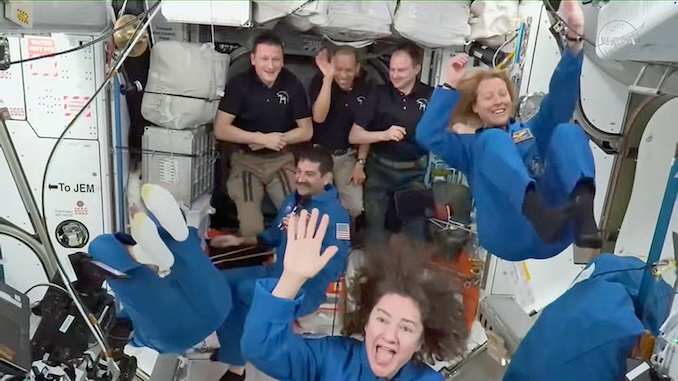
Humanity’s Orbital Home Returns to Full Strength: Crew Dragon Docks Successfully
The orbital rhythm of the International Space Station (ISS) has found its steady beat once again. On a quiet Sunday afternoon, the silence of the vacuum was broken by the precise, rhythmic firing of thrusters as SpaceX’s Crew Dragon capsule executed a flawless docking at the orbiting laboratory. At exactly 3:15 p.m. EST, the spacecraft made contact with the space-facing port of the forward Harmony module, bringing an end to a 34-hour high-stakes pursuit that began with a thunderous launch from the Kennedy Space Center.
This mission isn't just another routine pickup and drop-off; it is a vital reset for the station’s operational capacity. With the arrival of this replacement crew, the onboard population has been boosted back to its standard complement of seven astronauts. For the past several weeks, the station has been operating in a state of transition—a period where crew members often find themselves multitasking across scientific disciplines just to keep the lights on and the research moving. Now, with a full house, the station can return to the heavy-lifting of microgravity science and critical maintenance.
The delivery vehicle, a SpaceX Falcon 9, continues to cement its reputation as the most reliable workhorse in the history of spaceflight. While the world watches the explosive development of the Starship program in South Texas, the Falcon 9 remains the quiet professional, performing these complex high-stakes taxi runs with a level of consistency that was once unthinkable. This launch marks another notch in SpaceX’s belt as they dominate the "Low Earth Orbit" economy, proving that reusable rocketry is no longer an experiment—it is the bedrock of Western space exploration.
The journey from Pad 39A to the Harmony module was a choreographed dance of physics. Over the 34 hours following their Friday launch, the crew monitored automated approach maneuvers as the capsule drifted from a lower orbit up to the station's 250-mile-high altitude. The final approach was a masterclass in engineering, as the Dragon lined up its docking adapter with millimeter precision while traveling at a staggering 17,500 miles per hour.
Site Commentary
At SpaceRadar, we often talk about the "normalization" of space, and this mission is the perfect example. There is a certain irony in the fact that SpaceX has made these dockings look so easy that the public almost forgets how incredibly dangerous they are. However, don't let the smooth execution fool you; the stakes couldn't be higher. By returning the ISS to a seven-person crew, NASA and its international partners are maximizing the "science-per-hour" metric of the station.
Looking forward, the reliability we are seeing with the Falcon 9 and Dragon systems is the essential bridge to the Starship era. You cannot build a city on Mars or a base on the Moon if you haven't mastered the logistics of the 200-mile trip to the ISS. This mission proves that SpaceX has mastered the short-haul, allowing them—and us—to keep our eyes firmly fixed on the deep-space horizon. We expect the next six months to be some of the most productive in the station's history as this fresh crew hits the ground (or the deck) running.
Data Brief
- Docking Time: 3:15 p.m. EST at the Harmony module.
- Transit Duration: 34 hours from launch to docking.
- Current ISS Population: Seven crew members.
- Launch Vehicle: SpaceX Falcon 9 (Launched from Kennedy Space Center).
- Orbital Speed: Approximately 17,500 mph during the docking sequence.
- Mission Goal: To replace departing crew members and maintain full-scale scientific operations.
Sources
Primary sources include NASA Open APIs and official mission data feeds.